Business Design
Collaboration Simplified
Exploring a web-based application designed to make social learning more accessible.
Services
YEAR
Services
YEAR
Research METHODOLOGIES | QUALITATIVE RESEARCH | Business ModeLS DATA ANALYSIS Futures Thinking Frameworks Systems ThinkinG | SWOT ANALYSIS | REPORT DESIGN
2022
Secondary Research | Research METHODOLOGIES | QUALITATIVE RESEARCH | Business DesigN | Business ModeLS DATA ANALYSIS | Futures Thinking Frameworks | Systems ThinkinG | SWOT ANALYSIS | REPORT WRITING | REPORT DESIGN |
2022
Services
YEAR
Secondary Research | Research METHODOLOGIES | QUALITATIVE RESEARCH | Business DesigN | Business ModeLS DATA ANALYSIS | Futures Thinking Frameworks | Signal and Trend Forecasting | Systems Design Tools Strategy DesigN | Systems ThinkinG | SWOT ANALYSIS | REPORT WRITING | REPORT DESIGN |
2022
How might we make remote learning more efficient, expressive, and effective?
Benji is a web-based application that makes social learning more accessible for corporate educators in remote and hybrid environments. When we collaborated, Benji was in its beta stage with a small user base and needed to refine its business model, define its audience, and create a strategy for scaling. Founded in the year 2017 by Matthew Parson, Benji aims to transform the way learning is delivered in a remote or hybrid environment. The platform allows one to easily run the classic workshop activities like collaborative brainstorming sessions, breakout group work, and role-playing using asynchronous video as a primary feature along with the preferred video-conferencing platform.
Benji had identified three use cases as possible ways forward.
Asynchronous video collection: Learning is a social experience and Benji aims to provide a platform that can create asynchronous, remote experiences for its users using asynchronous videos.
Soft-skills training: Benji creates engaging and responsive soft skills training. It can facilitate a good dialogue and provide a platform to practice communication and public speaking, self-leadership, and creative problem-solving.
Brainstorming + ideation tool: Benji provides a platform to collaborate and hosts a variety of features that can contribute to brainstorming and infuse meetings with creative flexibility.

TASK
Our task was to help Benji:
-
Redefine its business model to better serve corporate educators and coaches.
-
Define its audience and value proposition to ensure product-market fit.
-
Craft an innovation strategy and launch roadmap aligned with its vision.
-
Develop measurable metrics to track user engagement and growth.
-
Identify opportunities for Benji to become a multi-sided platform, enabling scalability and sustainability.
CHALLENGE
The challenge was to make Benji’s platform foster a dynamic, interactive, and collaborative learning culture while staying easy to use (efficient), encouraging active participation (expressive), and improving learning outcomes (effective).
The goal was to shape the future of the company with a clear innovation strategy, value proposition, and growth metrics.

DISCOVERY + IMPLEMENTATION
To address these tasks, we took a structured double-diamond design process approach:
The first diamond is made of a divergent step of Discovery, in which the team collected information through primary and secondary research. Following this was a converging step of Definition, where this info was synthesized in artifacts such as research insights, which were also backed by foresight signals and trends.
The second diamond started again with a divergent step of Ideation, where the team proposed and discussed many possible solutions to the innovation intent. Following is a convergent Implementation phase where we addressed opportunity areas of the platform with use cases, platform capabilities, validation and communication strategies backed by resilience and leadership

ADAPTED FROM DAN NESLER, 2016
ACTION
To address these tasks, we took a structured double-diamond design process approach:
Discovery + Definition
-
Conducted a horizon scan and competitive analysis to understand industry shifts and benchmarks.
-
Interviewed users (e.g., leadership coaches) and tested the platform to capture real user experiences.
-
Performed SWOT and STEEPV analyses to identify strengths, weaknesses, opportunities, threats, and relevant trends impacting remote learning and collaboration.
-
Synthesized findings into research insights backed by foresight signals and trends, which informed Benji’s audience definition and value proposition.
Ideation + Implementation
-
Proposed workshops to co-create innovation intent and explore future scenarios.
-
Proposed multiple solution directions and converged on the most viable strategy.
-
Defined opportunity areas, platform capabilities, and use cases.
-
Designed validation and communication strategies to support implementation and growth.
-
Recommended metrics to track user engagement and set Benji on a path for continual improvement.
EXISTING BUSINESS MODELS
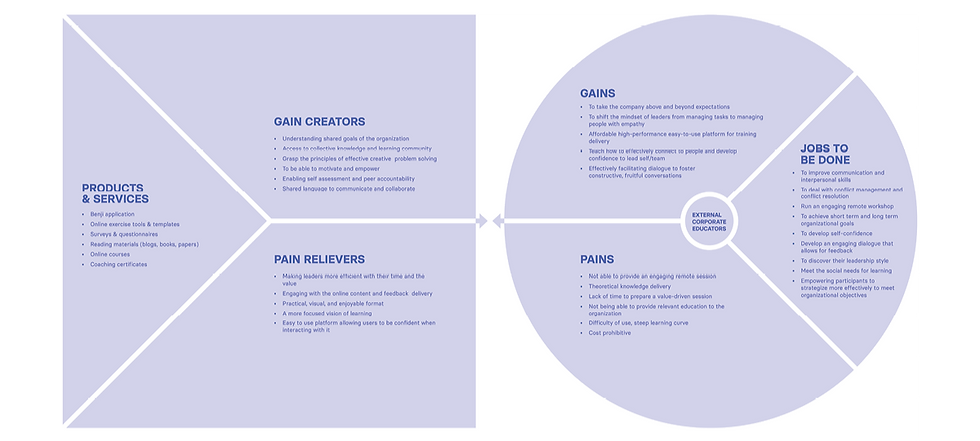
As a beta-stage startup with a small user base, Benji’s business model did not yet fit into a clear pattern. Using the Value Proposition Canvas, we identified alignment between Benji’s offering and customer needs. The platform’s early adopters were primarily external leadership coaches who used Benji to deliver their collaborative learning sessions.

EXISTING VALUE
PROPOSITION CANVAS

SWOT ANALYSIS
The SWOT analysis outlines key observations of Benji which are considered when exploring alternate business models and recommendation areas. This analysis helps identify what Benji offers currently, and where the greatest opportunities lie
for it.
SWOT ANALYSIS
STEEP-V ANALYSIS
The STEEPV analysis examined signals and trends shaping Benji’s environment. The following signals give us a look into the current environment that Benji exists in. The COVID-19 pandemic had created strong demand for platforms like Benji as remote work surged. As organizations began returning to physical or hybrid workplaces, we explored how Benji could adapt to this shift.
Remote work was evolving into hybrid models, creating opportunities for Benji to fill gaps with engaging, collaborative experiences. Although many online learning platforms reported declining usership, there were positive signs for Benji as users sought simpler, faster digital solutions. These trends highlighted opportunities for Benji to expand and evolve its offering to reach wider audiences.


INNOVATION INTENT
By 2027, Benji will be the trusted platform for experiential engagement by enabling users to co-create an immersive ecosystem for effective collaboration.

FREEMIUM WITH CUSTOMISATION
We recommended that Benji adopt a freemium model with enterprise customization. The freemium approach would showcase Benji’s value by offering key features for free, attracting users at a low acquisition cost and encouraging organic growth through network effects. As users experience the platform, they would be incentivized to upgrade to premium features, driving monetization through engagement.
Enterprise customization would allow Benji to target large organizations, offering tailored solutions that foster long-term relationships and exclusivity. This model also supports iteration, enabling Benji to refine features based on user feedback and scale sustainably.
PRIORITY ACTION
MATRIX
As we understood the platform's capability, we came up with an innovative intent that describes Benji as a leader in the collaborative digital space. The creation of innovation intent helped us identify opportunityareas for Benji to thrive and propel growth. A series of initiatives were developed under four opportunity areas having different levels of im-pact and scale. We mapped the initiatives into specific quadrants with low to high impact and low to high effort.

VIABLE SYSTEMS
MODEL

RESULT
The project culminated in a comprehensive strategy report that:
Clearly articulated Benji’s audience, value proposition, and innovation intent.
Delivered a launching strategy with measurable growth metrics.
Identified opportunities for Benji to evolve into a multi-sided platform, broadening its reach and accelerating growth.
Positioned Benji for success in a post-pandemic hybrid learning landscape by focusing on collaboration, engagement, and scalability.
IMPACT
Benji emerged with a clear roadmap for product evolution and growth, enabling them to better meet the needs of corporate educators, boost user adoption, and create a dynamic, interactive learning culture.

PROJECT LIMITATIONS
We acknowledge that Benji is in its learning and discovery phase at the beginning of the design process which allows customers and their needs to be prioritized so it improves the outcome of Benji for its users. BuildIng off of these findings and moving into the ideation and development phase, we propose that Benji adopts a business model that is sustainable and defined by key performance indicators, an external environment analysis, and identify areas of opportunity.
Moving forward Benji can enhance its engagement and expand its customer base by adding potential capabilities that result in the adoption and retention of its customers across varied segments and industries. We see Benji as an exciting platform that can facilitate engaging experiences for all its users.
The project listed is a team project completed as part of the Business & Design Thinking + Leading Innovation courses undertaken in Spring Summer 2022 at OCAD University for the Strategic Foresight & Innovation (M.Des) Program.
DURATION - APRIL 2022 TO JUNe 2022
ADVISOR - N. HARFOUSH, R. Barreda (OCAD UNIVERSITY)
ImageS - Freepik, Unsplash
CREDITS - T. Fernandes M. Jacula N. Khan V. Soneji